


Rural municipalities across Alberta are facing a growing infrastructure deficit that threatens both community well-being and provincial prosperity.
RMA members manage the majority of Alberta’s roads and bridges and thousands of kilometres of linear water utility systems, but provincial funding has been declining in recent years, and federal funding formulas continue to overlook the unique realities of rural communities such as longer distances, smaller tax bases, and higher per-kilometre costs. This has left rural municipalities struggling to maintain essential assets.
Sustainable, predictable funding is vital for the sustainability of rural municipalities. Rural roads, bridges, and utilities are not just for local residents; they are the backbone of Alberta’s economy, connecting industries with access to markets and natural resources, and linking families with communities. To ensure these systems and the industries they support remain reliable, municipalities and the province must work together on funding approaches that reflect rural realities and support proactive, long-term infrastructure planning. By building this partnership, the Government of Alberta can foster both local and regional resilience and province-wide prosperity.
Continue reading to learn more about the issue at hand. Then, download RMA's Member Toolkit resource to help advocate and close the gap.


RMA is conducting this five-week campaign to draw attention to the escalating rural infrastructure deficit, demonstrate that funding rural infrastructure is a strategic investment in Alberta’s long‑term prosperity, rather than a cost to contain, and highlight the urgent need for investment in rural infrastructure. This campaign will walk Albertans through the deficit step by step – from the scale of the problem, to its economic impacts, to the urgent need for reinvestment – and build a clear case for why rural infrastructure must be treated as a provincial priority. Each week highlights a different part of the story, culminating in a call for the Government of Alberta to partner with RMA and rural municipalities on long‑term, predictable funding solutions and short-term, essential increases to existing funding programs that reflect the essential nature of rural infrastructure.
Overall Deficit Results Summary
Throughout 2024, RMA worked in collaboration with Tantus Solutions Group to develop a series of reports to quantify and better understand the rural infrastructure deficit. To learn more about the scale and nature of this issue, RMA’s Infrastructure Deficit Project reports can be found here:
Overall Rural Municipal Infrastructure Deficit
Putting all three studies together reveals an alarming deficit figure.
Collectively, across all asset types, the RMA member Infrastructure Deficit is $17.25 billion.
The graph below shows that the overall RMA member portfolio is well below the target condition level. All three asset types currently sit on an expensive point of the curve, which increases the risk to fundamental usability, safety, and reliability of the network.

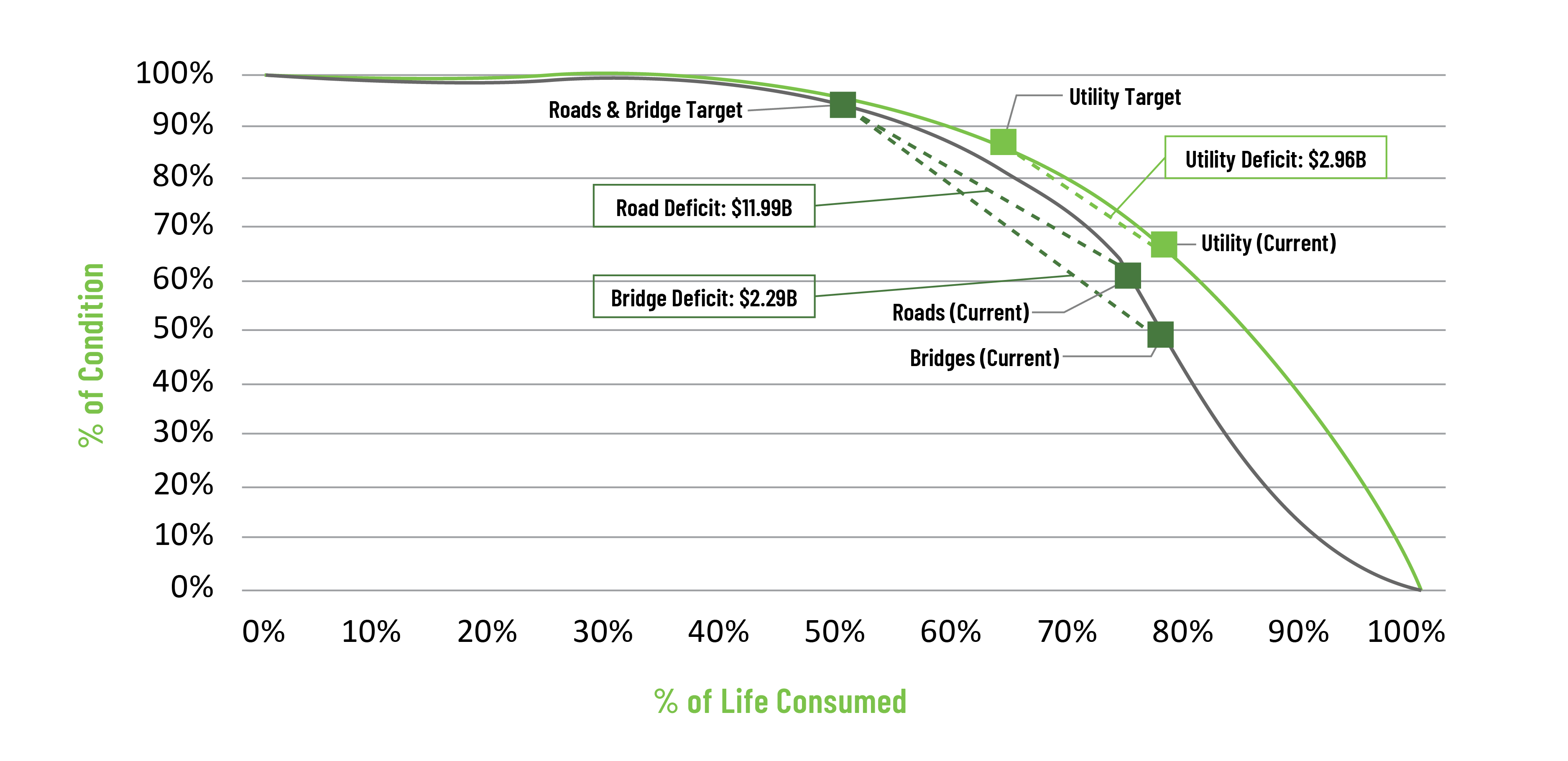
Grey Line = Inverted S-Curve (Road and Bridge Assets) | Yellow Line = Utility Curve (Utility Assets)
The following table shows a comparison between the current portfolio and a hypothetical ideal target state portfolio. The comparison shows overall portfolio values, life consumed, condition, the annual holding cost (investment required to hold the position on the curve), and the effective age.
|
CATEGORY |
CURRENT |
TARGET |
|---|---|---|
|
Deficit: |
$17.25 Billion |
$0.00 |
|
Portfolio Value: |
$34.75 Billion |
$52.00 Billion |
|
Life Consumed: |
76.01% (weighted average) |
50.00% (Bridge & Road) |
|
Condition: |
61.46% (weighted average) |
93.96% (Bridge & Road) |
|
Holding Cost: |
$6.41 Billion |
$1.17 Billion |
2023-2028 Outlook
If the Government of Alberta maintains current grant funding levels and methodologies for municipal infrastructure, 2028 will see a dramatically decreased infrastructure portfolio condition rating. Such a decline in condition places serious risk to the viability, resiliency, and safety of core municipal infrastructure.

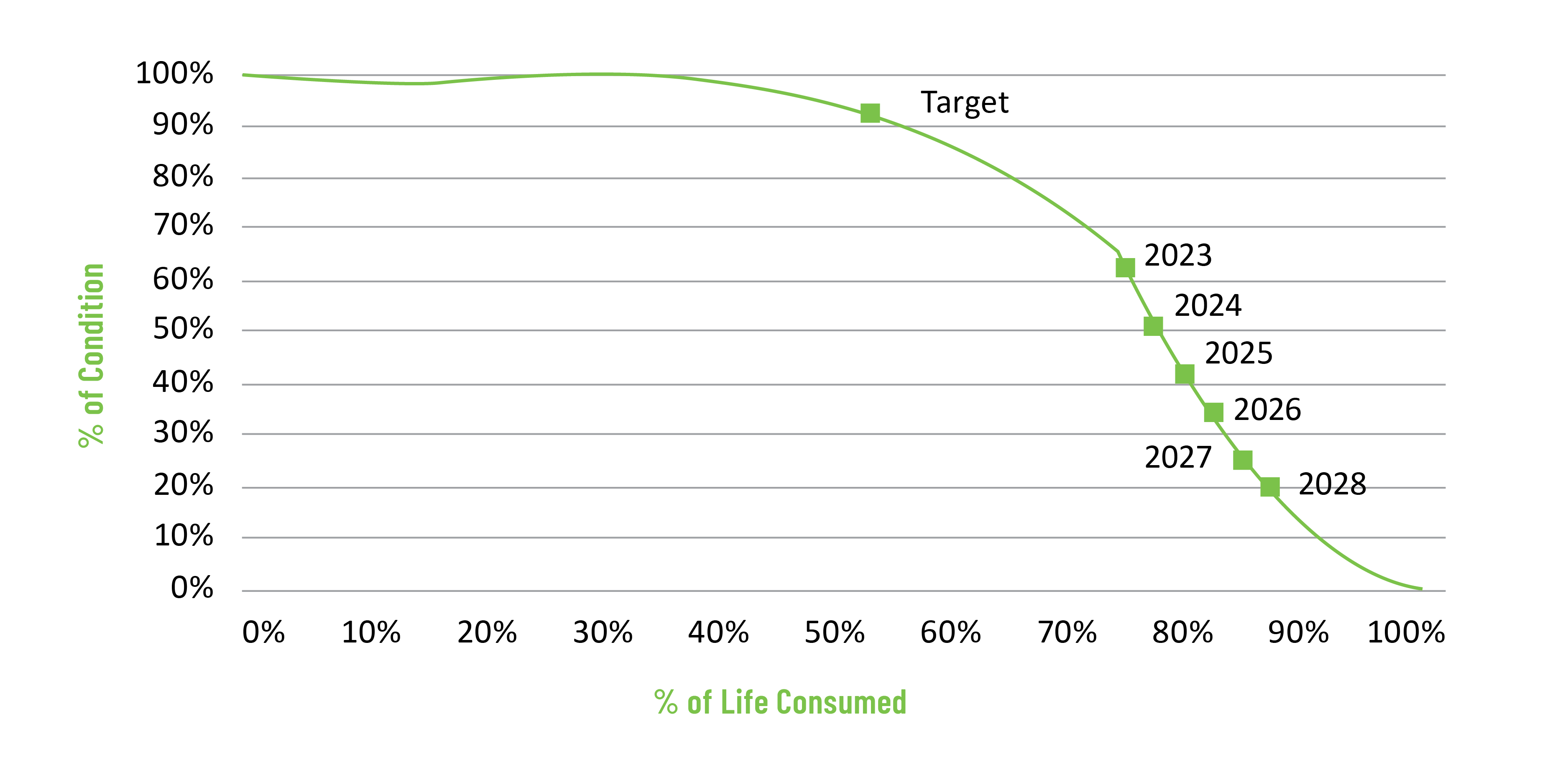
Note: This graph provides an estimate of future conditions and may not align precisely with the life consumed shown in the subsequent chart. While both are closely related, the chart figures should be considered more accurate in representing future conditions.
The current level of provincial funding is nowhere near enough to maintain the current 67.20% condition rating. Further, in 2028, the cost to move the portfolio to the target levels will more than double to $40.71 billion. This highlights the urgent need for increased funding and strategic investment to prevent further deterioration and ensure the safety and functionality of core infrastructure.
|
Year |
Life Consumed |
Condition |
Value |
Holding Cost |
Cost to get to Target |
|---|---|---|---|---|---|
|
2023 |
76.01% |
61.46% |
$34.75 Billion |
$6.41 Billion |
$17.25 Billion |
|
2024 |
78.91% |
50.47% |
$28.54 Billion |
$5.57 Billion |
$23.46 Billion |
|
2025 |
81.80% |
40.97% |
$23.17 Billion |
$4.15 Billion |
$28.83 Billion |
|
2026 |
84.69% |
32.72% |
$18.50 Billion |
$4.15 Billion |
$33.50 Billion |
|
2027 |
87.58% |
25.73% |
$14.55 Billion |
$3.45 Billion |
$37.45 Billion |
|
2028 |
90.40% |
19.96% |
$11.29 Billion |
$2.72 Billion |
$40.71 Billion |
Calculating an Infrastructure Deficit
Given the target point on the curve above, the infrastructure deficit is the difference between the current condition of assets observed and the target state level of condition. The deficit calculation, therefore, is based on the one-time investment required to move the portfolio to its target state, and can be represented by:
Infrastructure Deficit = Portfolio Target State Value ($) – Portfolio Observed Condition Value ($)
Financial Summary
As noted above, the overall infrastructure deficit for RMA member-managed bridges and culverts is $2.29 billion. To understand the gravity of this number, there are a few things to consider. Firstly, it is important to understand the meaning of the term "holding cost".
Holding Cost:
How much it costs to keep the portfolio at the same condition level from one year to the next. As an example, if a culvert sits at 50% condition in 2023, it naturally deteriorates to approximately 48% condition in 2024, consistent with the deterioration curve.
The cost to “fix” the bridge in 2024 and return it back to 50% condition level constitutes the holding cost.


Rural municipalities manage a majority of Alberta’s roads and bridges yet receive only a fraction of provincial and federal infrastructure funding. According to RMA’s Asset Deficit Summary Report, Alberta’s rural infrastructure is facing a total deficit of over $17 billion as of 2023; since the Report’s release, that number has likely grown in excess of $20 billion. The rural road portfolio alone faces a deficit of nearly $12 billion, equating to $16,800 per rural resident; when including bridges and utilities, this rises to over $24,000.
Current provincial allocations cover less than 5% of annual infrastructure holding costs, forcing municipalities to spend upwards of 50% of their budgets on transportation infrastructure while still falling behind. This inequity often requires municipalities to increase property taxes on other ratepayers or reduce levels of service in other areas to try to mitigate the impact. RMA is calling on the Government of Alberta to recognize this imbalance and ensure funding formulas reflect rural cost drivers, such as remote construction locations, increased labour and maintenance costs, and longer overall lengths.
Learn more about the burden facing taxpayers here.
Call to Action
RMA urges the province to seize Budget 2026 as an opportunity to invest in rural Alberta and close the rural infrastructure funding gap by revising funding formulas to reflect rural realities and provide predictable, equitable support for the infrastructure that underpins Alberta’s prosperity. While immediate attention must be given to the fiscal imbalance, it should also be paired with longer-term commitments to collaborate on solutions that ensure rural municipalities remain partners with the province as they work together on Alberta’s growth.


Investing in rural infrastructure is investing in Alberta’s prosperity. Rural transportation infrastructure networks underpin key industries in the province; 41% of Alberta’s public and private investment is in rural Alberta, and 28% of Alberta’s GDP comes from economic activity within RMA member municipalities. Rural industries such as oil and gas, forestry, agriculture, and emerging sectors such as renewable energy, value-added agriculture, and data centres are dependent on rural transportation networks that connect them to markets across Canada and globally.
Working with rural municipalities to strategically invest in maintaining existing infrastructure and renewing Alberta’s aging rural transportation network offers the Government of Alberta a chance to strengthen its economic backbone, protect billions in asset value, and unlock new industrial opportunities. By treating rural infrastructure as a provincial economic driver, the Government of Alberta can ensure that every dollar invested delivers returns for all Albertans.
Why are rural infrastructure investments essential for Alberta’s future? Learn more here.
Call to Action
Investing in rural infrastructure is investing in Alberta’s future, and RMA urges the Government of Alberta to seize Budget 2026 as an opportunity to invest in rural roads and bridges as the backbone of Alberta’s economy. By prioritizing strategic reinvestment, revising funding formulas to reflect rural realities, and committing to predictable, equitable support, the province can unlock industrial opportunities, reduce long‑term costs, and secure prosperity for all Albertans.



Resiliency in rural infrastructure spans economic resilience, climate adaptation, and long‑term structural durability – all of which are essential to keeping Alberta’s economic engine running and ensuring the rural networks that support core industries remain reliable under growing environmental and industrial pressures.
Proactive investment in rural infrastructure is how Alberta builds that resilience. Once the condition rating of an asset falls below a certain point, the costs of repair and replacement rise quickly, and the risk of load restrictions, closures, or even structural failures increases significantly. With nearly 40% of rural municipal roads already below a 50% condition rating, many rural municipalities are approaching a tipping point where the costs of keeping roads, bridges, and essential corridors functional will become financially unsustainable.
By acting now to strategically manage and invest in rural infrastructure, the province can prevent escalating holding costs, protect public safety, and ensure rural infrastructure can withstand severe weather events and continue to support economic and industrial growth. Investing in resilience today ensures Alberta’s rural infrastructure remains reliable tomorrow, safeguarding both communities and the economy.
Learn more about infrastructure resilience here.
Call to Action: Build Alberta’s Future Resilience
Rural infrastructure resilience is essential to Alberta’s long‑term stability, safety, and economic strength. The risks of inaction are growing, and the costs of delay are escalating. Alberta has a critical opportunity to shift from reactive crisis management to proactive resilience planning.
RMA urges the Government of Alberta to recognize rural infrastructure investment as a cornerstone of provincial economic and community resilience. Budget 2026 is an opportunity to begin stabilizing aging assets, reduce long‑term costs, and ensure Alberta’s transportation and utility networks are resilient enough to withstand future pressures. By prioritizing resilience today, the province can protect communities, safeguard economic activity, and build a stronger, more secure Alberta for generations to come.

Fair and sustainable provincial funding is essential to maintaining the rural infrastructure that empowers Alberta’s economy, as rural municipalities manage the majority of Alberta’s roads, bridges, and utility systems. Despite changes to provincial funding frameworks in 2024, current funding levels do not reflect rural realities, such as larger and more remote geographic service areas, heavier industrial traffic, escalating construction costs, and more dispersed residential and industrial development. When funding amounts and formulas do not align with these pressures, municipalities are forced to defer maintenance, reduce service levels, and absorb rising costs that ultimately weaken the infrastructure supporting Alberta’s core industries.
A fair funding model must recognize that the benefits of rural infrastructure are not strictly local; rather, rural roads, bridges, and utility networks are economic assets that benefit the entire province. Agriculture, energy, forestry, and emerging industries depend on reliable rural networks to move goods, access resources, and sustain supply chains. When rural roads and bridges deteriorate, industry costs rise, productivity declines, and Alberta’s competitiveness suffers. Ensuring that infrastructure funding formulas reflect unique rural cost drivers is essential to protecting the infrastructure that underpins nearly one‑third of Alberta’s GDP.
By adopting funding approaches that align with rural realities and keep pace with inflation and industrial demand, the province can reduce long‑term costs, strengthen economic growth, and ensure rural infrastructure remains safe, reliable, and resilient. Investing fairly in rural infrastructure is investing in Alberta’s prosperity – supporting the communities and industries that power the province today and into the future.
Review RMA’s recommendations for improvements to provincial infrastructure funding here
Invest Today to Protect Alberta’s Prosperity Tomorrow
Alberta’s economic engine runs on rural infrastructure. Budget 2026 is the moment to invest fairly, reflect rural cost drivers, and protect the networks that keep industry moving. Strategic investment today will reduce long‑term costs, prevent failures, and secure Alberta’s competitiveness for the future.


Over the past five weeks, RMA’s Closing the Gap campaign has highlighted the growing rural infrastructure investment gap and its impact on Alberta’s economy, industries, and communities. Each week has shown how aging assets, widening funding pressures, and misaligned provincial programs are placing rural municipal infrastructure assets at risk despite their central role in supporting the province’s economic engine.
Week 5 brings these themes together. This final installment summarizes the key findings of the Rural Municipal Infrastructure Deficit Project (RMIDP), reinforces the economic case for long‑term provincial investment, and provides a clear call to action as Budget 2026 approaches. It’s a moment to reflect on what the campaign has revealed, and to equip members and the public with the tools needed to advocate for fair, future‑ready investment in rural Alberta.
View the campaign summary and RMA's recommendations here.
In the Media

Lethbridge News Now
RMA’s “Closing the Gap” campaign seeks to partner with government to support rural infrastructure


Western Wheel
Funding reset necessary to halt snowballing infrastructure deficit, rural association says
Get Involved
It’s time for the Government of Alberta to partner with RMA and rural municipalities to approach rural municipal infrastructure as an investment that is essential to Alberta’s prosperity.
Contact your local MLA and tell them it’s time to invest in rural roads, bridges, and utilities. By supporting increases to predictable, equitable funding programs, you’re helping protect your rural community’s future and strengthen the economy for all of Alberta. Download the Member Toolkit resource here.

 Built with Shorthand